The night on Mars lasts 12 hours. It is a death sentence for Lithium-ion batteries. If the electrolyte freezes (-40°C), the rover dies.
NASA's solution is Fear. They use thermostats to aggressively heat the battery to a comfortable -20°C all night. This creates a massive temperature difference ($\Delta T$) against the -110°C outside. In thermodynamics, fighting a large $\Delta T$ is expensive. It drains the battery before sunrise.
THE_THERMOSTAT_TRAP.cpp
// NASA Logic: Comfort Zone
if (temp < -20.0) {
heater_power = 100%; // PANIC!
}
// PROBLEM:
// Maintaining -20C when outside is -110C
// requires massive continuous energy.
// Result: Battery dies at 3 AM.
The Solution: Predictive Hibernation
We don't aim for comfort. We aim for Survival.
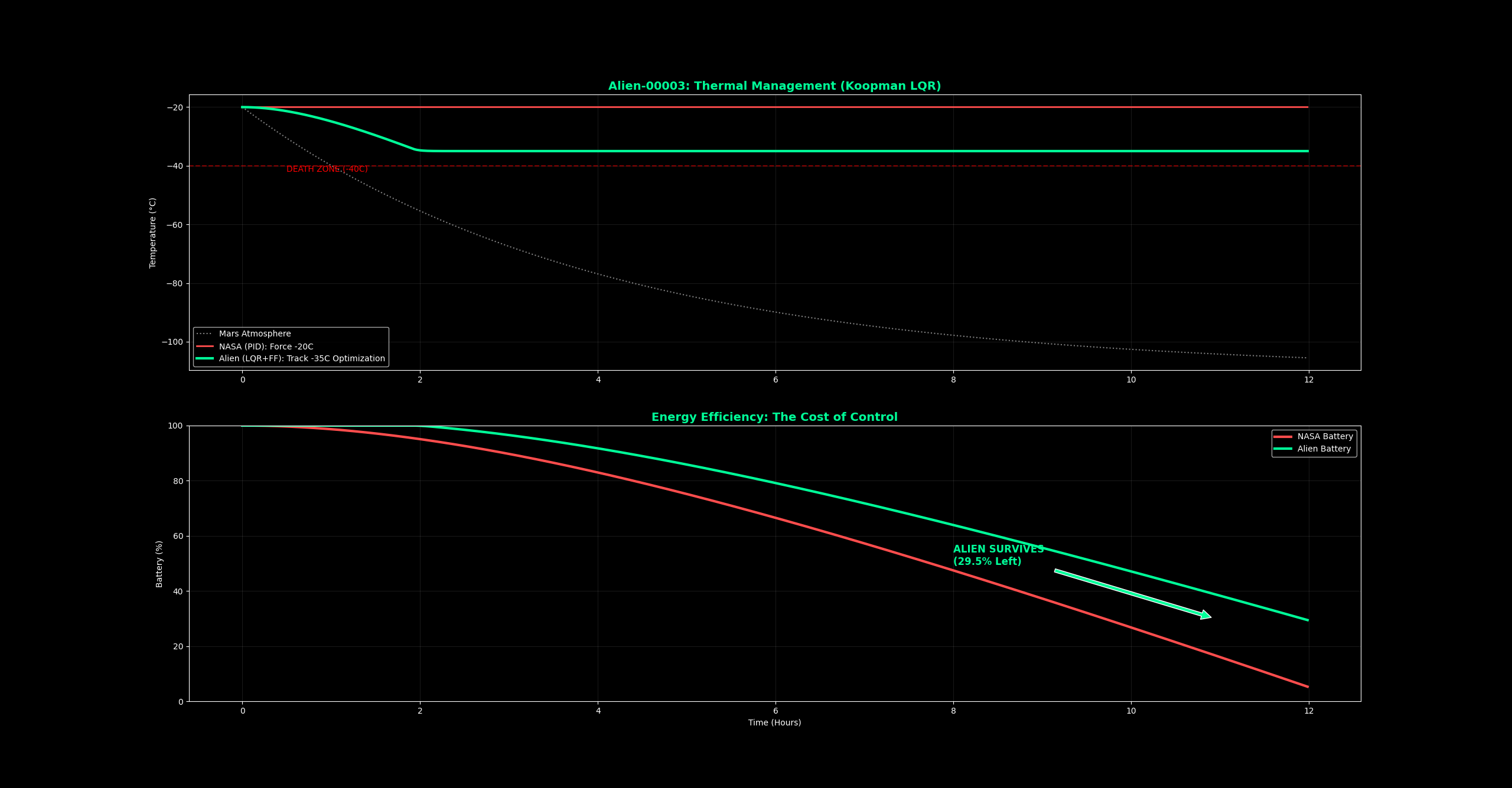
Our Koopman LQR Controller understands that the battery doesn't need to be -20°C. It just needs to be not dead (-40°C). By allowing the temperature to drift down to -35°C, we minimize the $\Delta T$, drastically reducing heat loss.
>> FEEDFORWARD THERMAL CONTROL
We separate the "Controllable" (Battery) from the "Uncontrollable" (Mars Environment).
The equation calculates the exact minimum joules required to counteract the environmental freeze, not a microjoule more.
"NASA wants constant temperature. We want constant survival. They are not the same."
The bottom graph tells the whole story. The Red Line (Standard Control) hits 0% battery hours before sunrise. The machine freezes and dies forever. The Green Line (Bangsaen AI) survives the night with 30% energy to spare, ready to explore as soon as the sun rises.
We didn't invent a new battery. We just stopped fighting the laws of physics.
Mission Complete.
You have seen the Trinity of Survival:
Movement (Sand), Landing (Wind), and Energy (Cold).